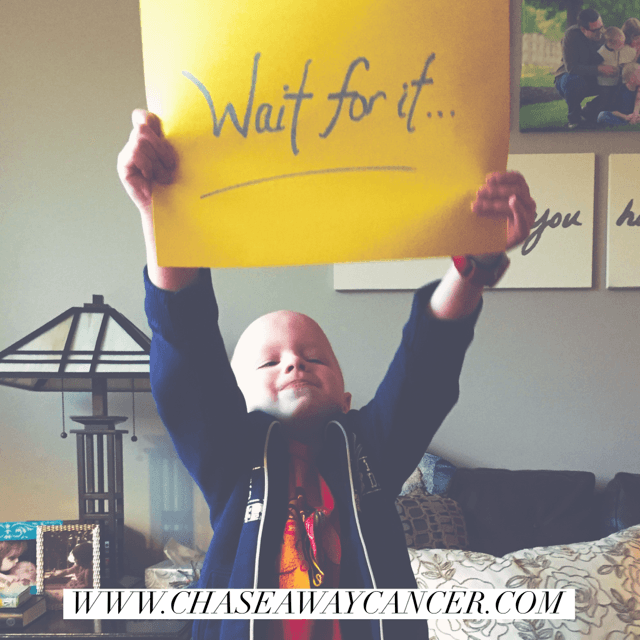
Yeah, so this warrior, survivor boy, he has some big news for you this week. Yes, you!
He’s been waiting with it for some time now and he was so fit to burst with the wonder of it that we had to do a photo rather than a video as he kept blurting it out at the top of his voice while he was dancing around with the sign.
I can tell you many things, but there is one thing I absolutely cannot even begin to describe.
There is a road I’ve thought I might see from a distance just a few times, but it is one I’ve never yet been asked to walk. However, one of the dear “cancer mama sisters of my heart”, Christina – she was asked to walk this road as her darling Noah went from her arms into Jesus’ on September 27, 2015 at 5:46PM. Just over six months ago now, and if you were to ask her, she might be able to tell you the days and maybe even the hours that have passed too. For Noah was just three when he stopped suffering and his family started anew.
Throughout this time, I have so admired Christina’s strength and faith and so when she opened up her hurting heart just recently, I asked her permission to share her gorgeous, raw words with you. Take a minute and hold her up in prayer as you hold up her honest, heartbroken words, and please, oh, please, let them change you as we live and move among the grieving.
Time sucks.
I am struggling with the fact that as it passes I am moving farther from the time I last held my son. Last held his hand, kissed his cheek, felt him breathe, fed him, heard his voice, and the list goes on. I know with each day that passes I am technically getting closer to the time we are reunited. But being in this middle is hard. It kind of feels like I am swimming away from an island where life wasn’t perfect but was good, towards a ship that I cannot see but know will be coming to rescue me. The island is moving farther away as I keep swimming forward, but I don’t know when I’ll reach the ship. And in the mean time I’m struggling just to keep my head above water. I know how to swim. And I know I’ll be rescued. But this period of time in the middle is so hard.
[stock photo credit: Pexels]
I’ve been given little rafts along the way, breaks in the pain, but eventually have to keep swimming. I’m trying to see the blessings God is providing. And there are many. Some days I see them more clearly. And other days it gets clouded. As life moves forward I have moments of feeling so alone. Around here it’s not commonplace to have a child die. We don’t see it happen on a regular basis in our neighborhoods, schools, groups of friends… I know it is in many other parts of the world. But our friends, family, coworkers, and classmates get to look forward to celebrating their kids/friends/siblings next birthday. Or look forward to summer with bike rides, pool passes, vacations. We do too, but with one member of our family missing. It’s raw, and devastatingly hard. Winter has been a way to hide from a lot of what I’m scared to face. The sandbox that’s not being played in, Noahs truck sitting in the garage, his bike that he never really got the chance to ride, other little brothers running around outside with their big sisters.
Tonight has been a lot of hard. Really since we came to the year of diagnosis it’s been hard. A lot of emotion and grief overflows. Life is moving forward and I feel like I’m ready for another raft to be thrown. In the beginning there are many, and now I feel like they’re farther apart. Mostly because I’m getting better at swimming. But when I tire it comes out of nowhere and I struggle.
Noah feels farther away, I don’t see a ship, and tonight I’m tired of trying to see the positive in everything. So I’m going to allow myself to feel, to be a little angry, and pray for some relief.
“You’re welcome to play in here until the nurse comes to get you.” The woman from the front desk wore a big smile and her eyes were understanding as we stood overwhelmed on that first day.
Radiation. The decisions had been irrevocably made. Chase needed further intervention to survive, and so we stood in this place and prayed against all odds and all side effects that it would work and work well. Oh, but my heart still hurt. Because some decisions still hurt even when you know they’re right just because they’re so crazy big.
It’s a good thing God knows all the things that I do not.
The play room was a small rectangular space with a fancy plastic kitchen set on one wall, a crafting center and school area against another, several shelves filled with toys, books, and games, and on the last wall was an entertainment center with a TV and several gaming systems – all of which Chase wanted to play and none of which he knew how.
But my interest was immediately drawn higher to the top of the center, where several poster boards and papers were propped. They were mostly thank you cards covered in children’s handwriting and colorful pictures, each one expressing heart-wrenching messages of thanks for life-saving treatments. But there was one piece in particular that held my attention.
It was a large, bright poster display with row after row of pictures. In each one was a beautiful little boy with dark eyes and a magnetic smile. In most of the pictures, he was accompanied by an equally beautiful woman whose perfect smile and weary eyes spoke volumes of cancer motherhood. I knew that look. In other pictures, there were people who appeared to be family members and sometimes even medical staff. The one constant other than the small boy in the center of each, was what they were doing. For, in every single picture, they held up hands and fingers (however many it took on the given day) in a gesture of marking time: day 1, day 10, day 22, etc… On that one bright board, they had wonderfully documented and counted each day of his treatment in the center.
And then as my white and weary Chase busied himself with trucks on the plush carpet at my feet, I studied the progression of the days and treatments – from the beginning with hopeful smiles and lots of hair to the end with joy, weariness, and what looked like lots of burns and bald.
And with the pictures was one strong thought that crossed my mind: “If this is as bad as it gets – we can do it too.”
So I held the image of the beautiful boy and his mama in my heart and every day as we went back for another treatment, and Chase grew increasingly weak, I’d quietly look to the corresponding day on the poster board and then look at Chase and remind myself that we could keep going because they’d survived too.
I now know that the boy’s name is Isaac and his life changed with a headache when Chase was only a one-year-old playing in the backyard. Isaac would finish his road through radiation a little over a year before Chase ever started. And as Chase’s 2015 ambassador year came to a close, we learned that Isaac would number among the new five who stood for 2016.
The label on Chase’s chart reads Atypical Teratoid Rhabdoid Tumor, and Isaac’s reads Medulloblastoma, and they have yet to meet face-to-face, but most days, I just marvel at how their lives have intertwined and mirrored and how Isaac’s story has encouraged us so much.
And isn’t this why we share our stories – even the hard ones? So that someone, somewhere, can remind their own heart “If they did this, then so can I.” As we share our experiences with each other and seek to encourage each other, we pass a baton. I have run and now it’s your turn. I cannot run with you, but I will stand and cheer you on because I know the course you’re taking.
Yes! This. I know I say it all the time, but I don’t think we can ever hear it enough: There is beauty and wonder in our broken, interwoven lives and even cancer can be used for far greater, far better purposes as we run.
Moment by moment.
April and Isaac in the play room – Day #23 [photo credit: April Adamo Schippers]
Tomorrow, Brave Isaac will shave his head for kids with cancer. For more on this great event, click here.
Isaac and his mom, April have taken their own experience and turned it into a great gift for others! Today, you can visit Camp Out From Cancer – their organization that provides care packages to kids with cancer (Including a tent! Our family was thrilled!)
And as always, for more on Isaac, the other 2016 ambassadors and the amazing work done by St. Baldrick’s, click here.
I first wrote these words on March 3, 2013 in the height of treatment and I marvel at some of the ways the awful cancer shows the goodness of God. His way are not ours…
A reminder for your day: whatever burdens you is not too big or great for The One who loves you.
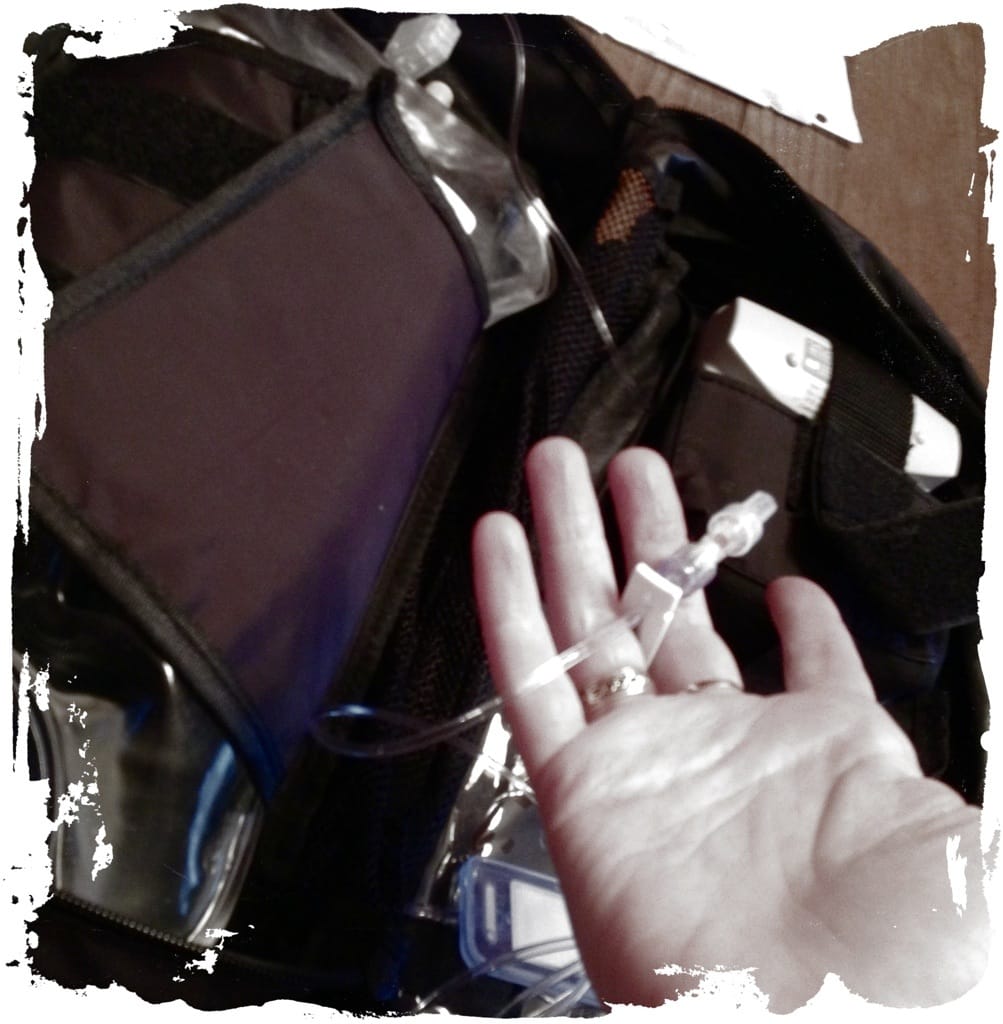
Sixteen of Chase’s every twenty-four hours are spent attached to an IV bag. This bag, its carrying case and the pump weigh about as much as he does (when the bag is full) and he must drag it behind him everywhere he goes. In addition to the weight, the cord has a short range, so he can only walk about two feet before it pulls and strains; reminding him to pick up the burdensome piece again. The moment it beeps (a notification that the cycle is complete) is the happiest moment of his day and as soon as he’s detached, he immediately starts running and jumping…two things he really can’t do without causing harm when the bag is on.
However, there was a day last week when the IV pump notified it’s completion, and instead of the jubilant “My baggy’s done!!” that I usually hear, there was silence. I went to him and said “Chase, your bag is done! Do you want me to take it off for you?” He sighed and said “Not right now, Mom. I’m playing…maybe later.” He had become so engrossed in his play that he was no longer energized to remove that awful shackle of a bag.
And I suddenly saw myself in this encounter…
How often I struggle with fear and sin that -with God’s help- I could lay aside! I could find peace, find rest, and be free of whatever burden holds me. He comes to me, much as I came to Chase and says “It is finished, this can be removed…will you let me do that for you?”…yet in my foolishness, I am content to play while my worry and fear is attached to my very life vein because I am too preoccupied to see that He stands there -more able than I will ever be- ready to remove it.
“…let us also lay aside every weight, and sin which clings so closely, and let us run with endurance the race that is set before us, looking to Jesus, the founder and perfecter of our faith, who for the joy that was set before him endured the cross, despising the shame, and is seated at the right hand of the throne of God.” Hebrews 12:1b-2
We sat curled up on the bed – just her and me – the only two girls in this whole house full of boys.
“Do you want to talk about it?”
Darcy’s nearly ten-year-old voice was calm as she described almost dispassionately what it was like to discover her two-year-old brother having a seizure when she was only six. And then, her tone changed and suddenly, like a full-fledged adult, a hand came up to her face as her eyes welled up. “I’m so sorry…I don’t know what happened. Sometimes I can’t talk about this without crying…”
Oh, how I know that feeling! Even when Chase is in the next room – living, breathing, and probably getting into trouble, the flashbacks can still take my breath away in an ordinary conversation.
Darcy and I ended up talking for a long time and crying some too, and it lead to these words… Because sometimes I forget how hard this is for her, Aidan, and Karsten.
Aidan, Chase, and Darcy [photo credit: Jan Terry]
For the “cancer” siblings: especially the littles…
Set the tone for understanding — To a child, sickness (of any kind) is contagious. I didn’t know this until we talked, but that early Tuesday morning when Chase was taken to the ER and Darcy and Aidan cowered in the shadows of their room, Darcy kept watch over two places. She told me she’d go to the window and check to see if the paramedics had taken us out yet, and then she’d go back and check on Aidan to see if he was seizing too. She stood in the dark of the room and thought it could be all of them…all of us. It would be some time before she and Aidan fully understood that cancer could not be caught from or given to another person.
Presence can mean peace — They say nothing is worse than whatever you imagine and I think it may be true. We couldn’t always bring siblings to the hospital because Chase was in isolation so frequently, and our gut was to keep the very worst of diagnosis and treatment from them on some level, yet, Darcy told me that the times she felt most at peace were when she could either come to the hospital and see Chase personally, or when we’d FaceTime from our room in the oncology floor to Grammie’s house. She could see the IV cords and watch him vomit, but she could also see that he was alive and that was what brought her the most joy – just seeing he lived.
Set the paradigm — This one is kind of interesting to process because Bob and I actually didn’t have the luxury of telling our kids Chase had cancer. We were completely separated from them for a full week and their grandparents had to tell them before they found out from a third-party as loving friends surrounded them in those first days. But that being acknowledged, we’ve found (through trial and a lot of error) that explanations whenever possible can be very helpful. Whether it’s why Chase was getting gifts and special attention or why mom and dad seem so distracted, tired, or weepy, sometimes an age-appropriate conversation provided better understanding than pretending it wasn’t happening, brushing questions aside, or simply evening out special gifts among siblings. Our family motto has become: “There’s nothing we can’t talk about”. Hard, but good.
Help direct emotion — Chase’s siblings cannot live through all that they’ve seen and not be significantly changed. Whether it’s memories of me laying on a gurney clutching their motionless brother to my chest or listening to kids making fun of a post-treatment Chase behind his back, there is a lot of fear, hurt and anger. A lot. We spend a significant amount of time talking through how those feelings of fear or angry protection are a completely normal human reaction to what they’ve experienced, but it’s what they do with those feelings that will define them. We pray often that these things would make them and not break them, and that they would be strengthened in compassion and prepared to defend the weak because of what they’ve lived. And then we try and find ways to apply it to the every day.
Be prepared for deep feelings — This one surprised me and still does. Somehow, I expect that a lot of what we’ve gone through went over their heads. Not so – at all. They may not understand the word “terminal”, but they can sense it. There have been times that Darcy wanted to sit and talk and then others, like when she’s at school, where she hasn’t wanted to talk about Chase’s story at all, but she’s very aware of it and who she is in it. She explained that the kids don’t understand and the teachers all want to hug her and while she appreciates the love, both of those things make her feel very vulnerable. She doesn’t want to cry at school, but sometimes she needs to come home and just have a good cry over it.
Look for seasons of rest — Having a sibling with special cancer or neurological needs is as full-time for them as it is for us as parents. Whether it’s making a concession over parental attention, curtailed family activities, partaking in extra “cancer activities”, or interacting with a neurologically, emotionally, sometimes physically demanding playmate 24/7, I sometimes don’t even realize (in my own exhaustion) how tiring living with a cancer sibling is for my other kids. But Darcy could explain it to me; sharing how sometimes she can’t handle Chase anymore, but other times, she misses him and is slowly learning to listen to him when he demands her attention because he says things like “I’m a survivor, Dars!” (his pet name for her). And like adults, the siblings can have a layer of guilt over annoyance during a stressed family dynamic – especially when it’s towards a family member with a terminal illness. The guilt alone is exhausting.
There’s just no wrapping these things up. They’re messy and the dynamics continue to unfold as the kids change and grow and Chase lives on in his complications and joy. Some days are beautiful and could be used as parenting seminar illustrations and others feel like a complete wreck in which we need a bomb shelter rather than a house, but spending time with Darcy on this subject reminded me once again how good it is to just sit, talk, and pray together. We are not alone.
Moment by moment.
“Teach us to realize the brevity of life, so that we may grow in wisdom.”Psalm 90:12
![[stock photo credit: Pexels]](https://mlbyxtvphejc.i.optimole.com/w:auto/h:auto/q:mauto/f:best/http://www.chaseawaycancer.com/wp-content/uploads/2016/04/black-and-white-boats-lake-three.jpg)
![[stock photo credit: Pexels]](https://mlbyxtvphejc.i.optimole.com/w:auto/h:auto/q:mauto/f:best/http://www.chaseawaycancer.com/wp-content/uploads/2016/04/sunrise-phu-quoc-island-ocean.jpg)
![April and Isaac in the play room - Day #23 [photo credit: April Adamo Schippers]](https://mlbyxtvphejc.i.optimole.com/w:auto/h:auto/q:mauto/f:best/http://www.chaseawaycancer.com/wp-content/uploads/2016/04/12115627_10207303122992704_468185666555167580_n.jpg)
![Aidan, Chase, and Darcy [photo credit: Jan Terry]](https://mlbyxtvphejc.i.optimole.com/w:auto/h:auto/q:mauto/f:best/http://www.chaseawaycancer.com/wp-content/uploads/2016/03/Siblings.jpg)
