The year I turned eight was the year my mom was pregnant with my last little sister. I was old enough to understand and be excited and each new and frosty December morning, I would run to my bedroom window to see if Miss Becky’s car was in the driveway. If her car was there, it meant my parents had gone to the hospital and my new baby sister had arrived.
Miss Becky went to church with us. I remember that her husband -Mr. Tim- was very, very tall to us, that one time, we went over to her apartment to help her get a cake in the shape of lamb for a baby shower, and that she had a huge smile and an infectious laugh. She also loved to talk about Jesus. But not how most people I knew talked about Jesus. She talked about him as if he was a precious friend, someone she really knew and loved and interacted with – much the same way I would talk about the friends I played with after school.
It was around the same time that I first have memories of her that Miss Becky got sick. She had something I had never heard of before, but I knew it must have been serious because I could see great concern on the faces of the adults when they spoke about it. They said my Miss Becky had something called cancer.
I remember that her hair looked different for a while but nobody ever told me that it was a wig. Kids don’t always get told those kind of things. And of course, I had no knowledge of things like procedures or chemotherapies, but almost every night, during our family times, we’d pray for Miss Becky to be healed from this strange thing called cancer.
Me with my precious “Miss Becky”
Our precious Miss Becky won her battle with what I now know was breast cancer while I was still very young. The years passed and she had children of her own and our families ended up at different churches. It would be years before I’d see her again.
When Chase was diagnosed with cancer, Becky was on the front lines of those who prayed for us and encouraged us. Cancer can make things very personal and re-knit friendships just in the shared experience. She knew what it was like for my Chasey to have the chemo taste in his mouth, the chemo-induced neuropathy that made his hands and feet tingle like they were asleep, and the hard, long days in the hospital. She knew and she prayed for us.
When Chase finished treatment, we saw each other at a party and I watched her watch Chase as he ran up and down the length of the gymnasium. Her, with the beautiful, big smile and marvel of his energy and life. And we talked about how she’d been free herself for twenty-six years.
We saw each other again last summer at the ball park and we picked up right where we’d left off. She always encouraged Chase in such a beautiful way, making a big deal about his battle even though she’d fought her own. And her smile was as big as ever and her love for Jesus was as real as ever.
Chase, Becky, Darcy and Karsten at the ball park
But not so very long ago, after twenty-eight full years, there were tests, and confirmation, and then a quiet picture of a beloved and dog-eared page of her bible –
“…that we might not rely on ourselves but on God, who raises the dead. He has delivered us from such a deadly peril, and he will deliver us. On him we have set our hope that he will continue to deliver us, as you help us by your prayers. Then many will give thanks on our behalf for the gracious favor granted us in answer to the prayers of many.” 2 Corinthians 1:9-11
Next to these words were written two dates – “11/87” and “10/15”. The implication was clear: the reprieve was over and Becky’s cancer was back.
Even as I write, she is in the middle of this second fight, but as it has unfolded and she’s let us have a glimpse into this second journey with her, it’s been an amazing honor to witness. She’s honest about the tears and weakness, but she’s also honest about her joys and her love for Jesus is clear throughout her words. After I posted a picture of Chase going to his hospital dressed as pirate last week, she sent me this picture in return…
Becky with her oncologist
Inspired by Chase’s fun, she’d found a fun way to show her courage and strength as well. And this beautiful woman clearly rocks a head scarf like none other.
All these seemingly flailing string ends, pieces of lives and stories so senselessly hit with diseases like cancer; I believe they’re being braided and woven into a tapestry we just can’t see or understand yet and it includes tiny bits like pirate costumes.
Because sometimes, it takes an eye patch to get just a hinted glimpse of the goodness of God in weaving our lives together – even in the pain.
Becky’s twice-proved courage, Chase’s strength, and God’s grace . . . moment by moment.
“That which tears open our souls, those holes that splatter our sight, may actually become the thin, open places to see through the mess of this place to the heart-aching beauty beyond. To Him. To the God whom we endlessly crave.” Ann Voskamp
** For more on Becky’s life and faith, visit: https://byfaithbecky.wordpress.com/ **
How do you live out what you know? And how do you live out what you know when what you know is pain?
Chase has felt many needles. Needles for chemo, needles for blood draws, needles to keep him hydrated and pass life-saving medicines into his veins. So many times, his skin has been pricked and prodded – his hands, arms, chest, and even the heels of his feet. If you look closely, you can still see many of the scars.
And somehow, somewhere along the way, needles became synonymous with band-aids. This kid has accessorized with band-aids, played with band-aids, covered his arms with them in the hospital play room (which scared the living daylights out of his doctors who thought each of the ten band-aids up his arm were genuine) and competed against siblings for who has the most (spoiler alert: it was almost always Chase).
Band-aids have been a part of his life and a sign of his pain, and yet, this last week when his kindergarten class celebrated their “100th Day” of classes, Chase wanted to cover his “100 poster” with band-aids.
So, we sat at the kitchen table and covered a poster board in the little brown pieces of adhesive and we talked. We talked about gauze and flushes and old stories where he had screamed and been afraid. Sometimes just being around the familiar supplies is enough to trigger the memories. And then, just at the moment it all felt a little sad again, we decided to look at the things we were most thankful for in those memories. And you know what? There were quite a lot of things for which to be thankful.
These band-aids started as a picture of hardship and ended up on a poster full of memories. I can’t help but wonder if the moment pain crosses into beauty is the moment it forces us to be thankful.
And as he painstakingly wrote out “Chase 100” on the top of his poster, he paused for just a second to consider, and then added an exclamation point. As he finished, he turned to me and explained: “Chase. 100. Exclamation point, Mom. Do you know why?” He ran on before I could have answered if I’d wanted to. “It’s because this is happy. You put an exclamation point” his lips curled extra hard to form those words; “when things are happy.”
So there you have it . . . Lessons drawn from a band-aid, a poster, and a little boy who has been so brave.
As he stood before me, he nodded somewhat unwillingly. “Okay, fine. Just one picture…”
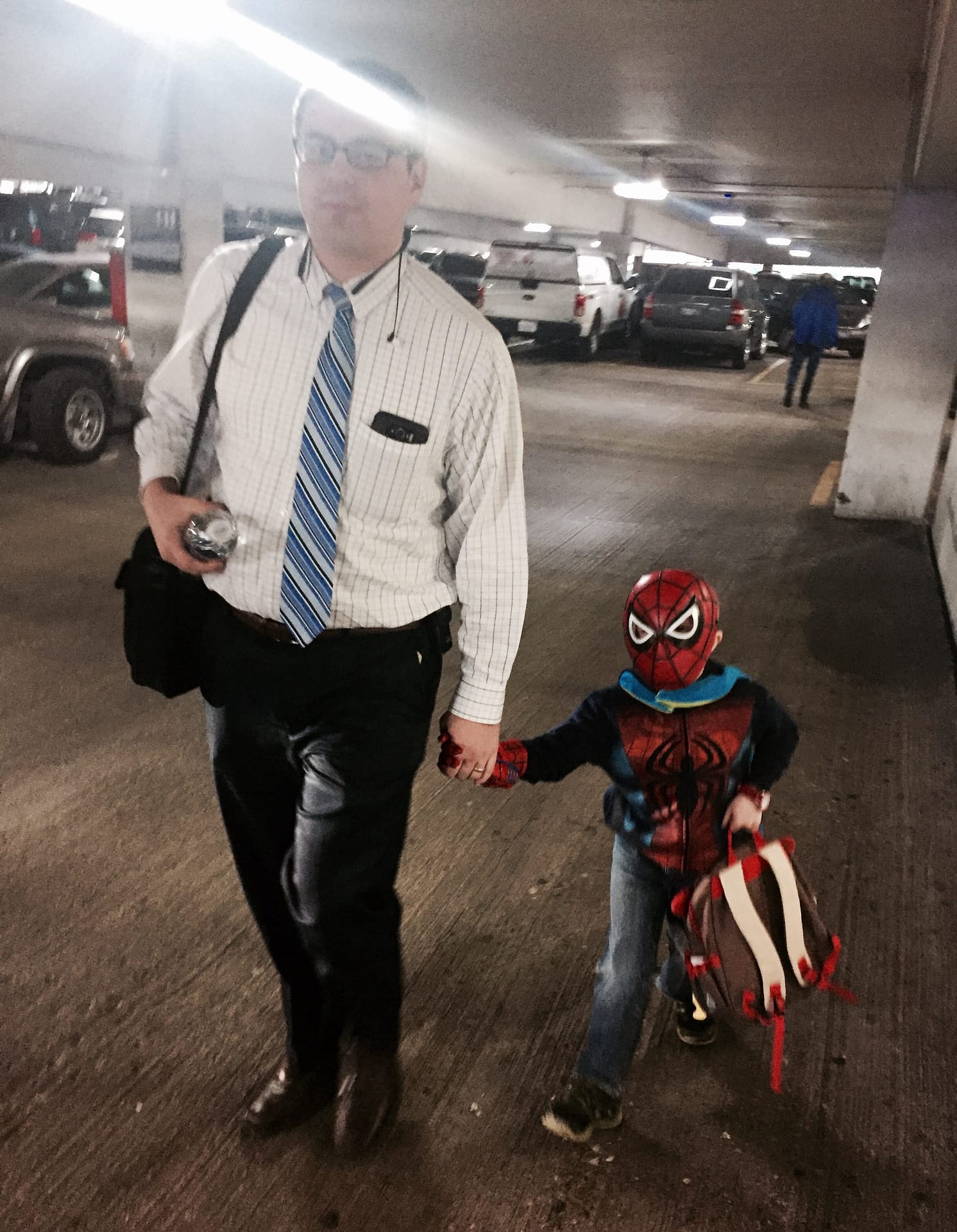
Chase was going to “his hospital”, and he was going as a pirate. Because nothing says “this is who I am” like a pirate costume. Due to a slight cold, I would not be joining them on the oncology floor that day and so it was extra special because it was “time for just Chase and Daddy” – the very best.
Occasionally, I drop hints in my writing about Chase’s aggression and I have trouble doing much more than that for several reasons. I think mostly because there is rarely any redemption or beauty that would benefit you from reading about it in greater detail. It is sad and ugly and Chase is deeply ashamed of it. Whenever we talk about what happened during his angry moments, he dissolves into genuine tears, promising never ever to do it again.
And so, there has become this other quiet side to our lives that in some way seems less real because I don’t write or talk about it the same as I do other facets, and yet, it is extremely real and taxing in our home and on our family.
Over the years, Bob and I have experienced shock and judgement on the occasions when Chase’s struggle rears it’s head in public. There are comments and suggestions, and the response that always breaks me a little: tears and the quietly whispered aside – “I don’t know what to say but I’ll pray”. I think I’d say that same thing to me if I were seeing it from the outside for the first time too.
And over the years, as people have witnessed the struggle in hospital and out, we’ve been told that we as parents were overindulgent and we must be spoiling him, that Chase needed boundaries, that he needed more control over life choices, that we were giving him too many choices, that we weren’t treating him normally, that we were treating him too normally, that the anger was his reaction to the out-of-control-ness of life in cancer treatment, that it might be the anti seizure medication he takes every day, that it stemmed from anxiety, that we needed to change his diet, that we needed to change his supplements, that we needed to change his environment, that it could be circumstantial, and various other things.
One of the hard, out of control moments
We’ve thought many times about getting help for him, but weren’t even sure what “help” should look like or who should provide it. We were often told that he was too young and his brain was still developing too much for anything to be of assistance, and were even told at one point that some specialists had no paradigm for a child who’d been through the extreme brain and emotional trauma that Chase had experienced. It was as if everybody knew on some level that it was happening, but nobody knew how to deal with it or what was at it’s root. A very isolating feeling.
Hearing that it was something we were doing was especially difficult. In the first week that Chase was diagnosed, Bob and I had determined that one of the very best gifts that we could give him was the gift of normal. His life had become extraordinary and we desired to keep that out of his way as much as we could, and so, we instituted loving boundaries in and around the chemo and treatment. How do you give a “time out” to a child whose life is a giant hospital bed punishment? You can’t… but maybe if a toy got thrown in anger, then the toy went into time out for a few minutes. Small things like that – the things that made him like his brothers and sister, like the other kids outside the hospital walls. But it was a constantly changing situation in which we were (and still are) always having to weigh out what’s chemo damage, what’s tumor damage, and what’s Chase. It was during this early season that I found the phrase I love so well: “There are only so many hills you can die on.” But despite our efforts, the rages continued unchecked. We felt like we were doing everything good parents were supposed to do. How was this our fault?
We plunged forward and fought these fights ever week and sometimes every day, and yet, we’ve felt largely unheard. Not because anybody’s ignoring us, but because I truly believe that the pediatric cancer survivor field is still significantly unfolding in this area. Think about it: Chase’s cancer has only been defined by name for about twenty years and it’s only been about seven since his treatment began as a clinical trial, changing statistics from completely terminal to marginally terminal, and suddenly, Chase’s generation of survivors are living long enough to really see what happens after the dust settles. Some days, our lives feels like the cancer equivalent of the old Oregon Trail – where we just circle up the wagons and try to survive.
Bob and I often liken Chase and his treatment to a house fire. When he was rushed in with his large mass, he was a house consumed. The teams of doctors were almost like teams of fire fighters, working collectively to extinguish the deadly blaze on all levels. You do what you have to do to save. And then we were done and thankful… But, who helps rebuild the house? You can’t expect the firefighters to do that for you.
Chase works with a occupational therapist during chemotherapy [photo credit: Cameron Dantley]
This is ultimately what lead to Chase going to the hospital as a pirate this cold winter morning – we were on a search for builders – master builders. (Sorry, this is what happens when you’ve watched The Lego Movie a couple hundred times with your kids) It was time to work at rebuilding and Chase’s primary team of doctors had recommended that he was now old enough for a neuropsychology evaluation. We were cautiously optimistic, having been warned that it may not explain his aggression, but would definitely show some of his strengths, weaknesses, and how he learned. But we could still hope. Maybe there would be something – anything – that could provide us with a clue as to how we could help him.
And so it began, hours of testing, piles of paperwork, and then a two hour meeting for which I was conferenced in. And Chase sat in the back of the doctor’s office and over the speaker on Bob’s phone, I could hear Matt Redman singing “10,000 Reasons” from the iPad. Some things never change. But what we learned in the meeting was both life changing and life amazing.
I marvel how so many cancer parents know exactly where their child’s tumor was located in the brain. I am not one of those parents. I asked some other crazy and weird stuff at the time of his diagnosis, but I never asked exactly where the tumor was located. At 6cm with midline shift and tumor cell metastasis, it seemed to be everywhere. Which is why it stopped me dead in my tracks to realize for the first time in three years that Chase’s tumor decimated his language center. Did you hear that? Chase shouldn’t be able to talk. I need to say that again because I want it to really sink in. Chase shouldn’t be able to talk. Those of you who have met Chase know the truth, and I’d like to think that through this blog, even those of you who haven’t met Chase know the truth. Chase talks. Oh my word, does he talk! And well, too. So take just a moment and breathe in this insane miracle of a brain that, freshly cut and traumatized, made the decision to move knowledge to a safer area, and compensating for itself, retained power of speech even after hours of being open on an operating table. God is good.
But the damage and the compensation and the radiation all carried a price and it had to come from somewhere. In this meeting, we found out that it had been taken out of a few areas, including Chase’s executive functions – his emotional regulation.
What followed were long and breath-taking explanations in which instance upon encounter began to click into focus and understanding for us, and several times, I was tempted to burst into tears on the conferenced call just because the meeting was the most incredible revelation.
There are only so many times you can be told that you’re doing something wrong as a parent before you begin to believe it, and this meeting was the first time in a very long time that it was acknowledged and known beyond a shadow of a doubt that Chase’s aggression isn’t due to something we’re doing or not doing. There is damage, it is real, and we learned that there might actually be ways to heal, or at the very least, help.
There is not a magic cure. The process of working with a traumatized brain like Chase’s is a life-long one. There will be more therapies, more meetings, and possibly even medication to help retrain and replace some of what has been lost. And this will change and grow as Chase changes and grows.
So why do I share all of this? First, because if someone had told me three years ago that survival would be this complicated, I wouldn’t have believed them. And there are a lot of struggling survivors around almost all of us, so look to them with understanding and grace. Second, neurological issues are often simple in their exhibited symptoms yet mind-blowing in their actual complexity. So, the next time you’re in a store and you watch a mom deal with a screaming, wailing, kicking, on-the-floor child, know in your own heart and mind that it could indeed be an issue of boundaries and you might do something different if it were your child…or it could be that her child’s shirt hides multiple port scars and his hat covers a giant resection scar and that mama is dying just a tiny bit inside because she doesn’t know why he’s on the ground, what made the anger so great over something so small. And as you watch her, know that she’s been to places that broke her and she’s being broken once again in the aisles of a store and she wishes for just a second that things were different.
We are so deeply thankful because, three years ago, we didn’t even know if Chase would live let alone function, but we are weary parents, and the bald pirate has a long road of work ahead. So we rely on neurological sciences, survivor breakthroughs, and prayer – knowing that our seemingly accidental stumbling through it all is part of a good and hope-filled master plan. And we begin yet another facet of this life . . . moment by moment.
“…More than 95% of survivors will have a chronic health problem and 80% will have severe or life-threatening conditions.” – St. Baldrick’s Foundation
Recently, as I put the littlest boys into bed, Chase stripped his shirt as he often does, referring to his white chest as his “rockin’ body’. As he passed across the room towards his bed, Karsten came to stand in front of him, stopping him, and asking with quiet interest, “Hey, Chase, what are those lines?” His small, chubby hand raised energetically to point at the slashes of central line scars that cover Chase’s upper chest on both sides.
For one small second, I held my breath. I wanted to jump in and explain. I wanted to “make it better” and take it away as I watched Chase begin to recoil. He hates questions about his physical appearance. And some days, I hate that all the kids know these strange and awful cancer-y things. But then, Chase stood up a little straighter, pressing out of his curve and removed the hand he’d used to quickly cover the scars, bringing his chest into the light.
“Karsten, do you know what these are?
Karsten shook his head and waited patiently as Chase puffed himself up with the self-importance of a sibling about to teach a great lesson.
“These are from my needles and surgeries.”
“Surgeries?”
“Yes. They’re from my cancer and my chemo. Do you know what chemo is?”
“Yes! He’s in the closet!” Karsten ran to the closet and scooped up Chemo Duck, bringing him back and placing him in Chase’s outstretched arms. “Here, Chase. Here’s Chemo. He’s probably a duck.” To Karsten, who was only 8 months old on the fateful day in 2012, “chemo” is just the name of a stuffed animal, not a torturous experience. I waited. Knowing what to say next was best left to Chase. Sometimes the simple dialogue between brothers is a thousand times more useful than maternal wisdom could ever be.
He nodded gravely. “Thanks, Karsten, but there was more chemo. From the doctors. And now look…” he flexed his arm in the air, looking up at it proudly. “Look at my muscles. Chemo gave me good muscles.”
At which point, I felt the need to interject and redirect. Some days memory doesn’t come easily for him. “Chase, the chemo killed your cancer cells.”
He nodded as if he’d known all along. “Yep. And my hair too. But now it’s coming back. See, Karsten?”
He flexed again as Karsten watched the whole show in somewhat awed silence. And then Chase stopped and looked at me.
“Hey, Mom? The doctors didn’t make me. I forget…who made me?”
I ruffled his whispy-soft head. “God did, my sweet boy.”
He nodded yet again. “Oh, that’s right. Good. I’m glad.”
Karsten jumped up and down at my side. “Me too! Me too!”
And then the moment of deep attention was lost and the boys went back to getting ready for bed and intermittently wrestling, for that is what most small boys love to do.
But I saw this amazing moment unfold before my eyes. Our history and our scars can hurt, can be shameful, stressful, and sad, but in the rehearsing of them, the telling of them to others, the owning of them, they point us to God in such unique ways.
“Okay, let’s just get your temperature and then you’ll be done.” The nurse turned from the blood pressure cuff attached to Aidan’s skinny arm and grabbed the thermometer, shoving it into a sanitary plastic sheath with a soft click.
“Open wide . . . under your tongue . . . now close.”
The room was still as Aidan sat tall, silent, and brave (despite his strep throat) on the end of the exam table.
With an unusual calm, Chase pulled himself out of the chair against the wall where he’d been sitting next to me, and he went to stand closer to the table – in his older brother’s field of vision.
“I’m here, Aidy,” his pet name for his near twin from the earliest days of learning speech. “I’m here if you need me. It isn’t scary, but if you get afraid, I’ll be right here.” Nearly the identical words a three-year-old Aidan had spoken countless times over a two-year-old Chase during myriad blood draws and hard hospital days. “I’m here.” I choose to put myself next to you and try to understand.
Cancer starts as these tiny microscopic cells that go terribly wrong and it wrecks so much life. It makes me angry to consider its senselessness. But in this moment of family practice and strep throat and a check for vital signs, there was yet another glimpse of beauty in the devastation they’d caused. The boys have been bent by it – we’ve all been bent by it – but in those times when it really counts, especially when it comes down to a doctor’s office, they bend toward each other. They reach with comfort and love for one another. And care for each other has come from the long years of fear and pain.
I believe there will always be something good that comes of it all and that the God-purposes far exceed the effect of microscopic cells. . . moment by moment.
“You intended to harm me, but God intended it all for good.” Genesis 50:20a